It was Picasso who famously said:
“I yam what I yam”… No, hang on … I think that might have been Popeye. Sorry.
It was Picasso who famously said:
“Beauty should be convulsive or cease to be”
Well, in this true story one of Picasso’s most famous works gets so convulsed it very nearly ceased to be, after a visit to view it by Yours Truly and a group of thirteen year old school children.
Warning: Art-lovers who are of a nervous disposition and anyone who works in the Tate Gallery conservation department or is among its curatorial staff should definately avoid this story.
Tate Gallery, ‘The Three Dancers’ by Picasso 1925.
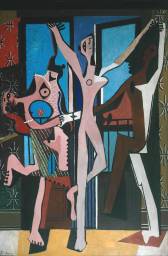
I’ve always really liked ‘The Three Dancers’. I think it’s the blue. I love that saturated Mediterranean cobalt /cerulean blue that provides the backdrop to the jumbled array of semi human shapes in front of it. I’d always found that it had a ‘contemporary yet retro’ feel about it, which satisfied my teenage post-Punk Jazzy leanings. Plus it had a dark, layered story behind it which I found fascinating. ‘The Three Dancers’ used to hang in the largely static Millbank Tate display, now the home of Tate Britain; and along with Matisse’s ‘Snail’ was one of the favourites that I used to go and say ‘Hello’ to each time I visited.
Of couse, the reason ‘The Three Dancers’ and ‘The Snail’ had this feel about them was that these were works by artists who were hugely influential on the development of the visual language used in commercial art, during the 1950s and 60s. Something, if not knowingly, I was steeped in.
The Tate Gallery Early 1980’s
As you may already be aware the Tate’s collection comprises the National Collection of British art from 1500 and International Modern and Contemporary art from 1900. Not exactly happy bedfellows, I think you’ll agree. Hence, the Tate Modern development which effectively took all the modern/contemporary work to the Bankside galleries and left the ‘boring stuff’ at what has become Tate Britain.
In the dark old days before Tate Modern, the collection was housed as I said, at the Millbank site. It had been built on part of the old prison (You can still see how local streets to the north follow its groundplan) and was paid for by the great sugar baron Sir Henry Tate. Just think: the existence of one of the most comprehensive collections of art in the country is in a roundabout way responsible for countless thousands, possibly millions of dental caries and cases of tooth decay.
By the early 1980’s, it was, if you’ll forgive me, a rather staid collection which had considerably outgrown its accomodation. Despite this, the displays changed rarely, although there was a notional annual re-hang.

Saint Sir Nick Serota
Then along came Contemporary Art’s ’Knight in Shining Armour’ (Saint) Nicholas Serota. Things soon started to change. He started by using the Duveen Galleries to rotate pieces from the collection, the displays became more varied. Although I was in support of Serota’s developments, on more than one ocassion, I found myself ‘caught out’, and plans to take a school group visit, had to be hastily adapted or re-arranged as the works I had intended we look at were not in fact on display. And so, it was that one day I found myself on the phone to the Tate Education Department to ask whether a visit could be arranged to see ‘The Three Dancers.’
Why?
Because? Well, because at some point early on in my Art teaching career, I had the bright idea of making a full sized version of ‘The Three Dancers’ with a group of kids.
I had been doing a painting project with a group of Year 8 students and noticed how difficult they found it to think of and use paint in any way other than thick blocked flat areas of colour. They drove me mad as they would attempt to paint and re-paint their work with standard school powder paint to achieve, regardless of what their subject actually looked like, a uniform, even surface – an impossibility.
Mind you, give the majority of the population of the UK a paintbrush, colours and paper and yell ‘PAINT!’ and they would do exactly the same. It was the first time it dawned on me that as a trained artist (I hesitate to say ‘well-trained’ as that is a whole new can of worms I’m keeping in the fridge for another time) I stood in front of the students with the experience of years of visual imagery, the vocabulary and command of language, plus all the other baggage that goes with being an ‘Art Teacher’, whereas the owners of the eager faces in front of me were light years away from the frames of reference which would allow them to access the conceptual and contextual place I inhabited. Phew! (I hope you notice I resisted the overwhelming temptation to use the words ‘mindset’ and ‘paradigm’ here: A major achievement I feel)
I began to think of how I might get round this and help them –
- Understand more about the qualities of paint – what you can do with it.
- Understand how to achieve these qualities themselves in a controlled way through
- colour mixing and all that it entails: mood, emotion, symbolism etc.
- Application of paint: brushwork, other methods of application.
- Formal qualities like texture, surface, tonal variations.
- Methods like impasto, washes etc. Techniques versus Experimentation
- And to understand why artists do the things they do: the all –important context ; and to give them a bit of respect for Artists. To begin to arm them with some of the basic tools – which would allow them to decipher or read artworks – even if it all it managed to achieve was a little insight, it was better than nothing.
So, after much deliberation (Probably the last hour in the Priory Tavern on a quiet week night) I hatched a plan which was to get them into handling paint more freely. By subterfuge. Trick them into it!
All I had to do was find an abstract/ish painting (one which would not allow them to get hung up on achieving a ‘likeness’ to anything they might see, or think they might see in it.) Preferably a painting with a story, which when it was finished, could be revealed and de-bunk the notion that ‘Modern Art doesn’t mean anything’. It also needed to fit the bill in terms of its freedom and handling of paint.
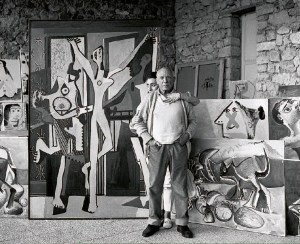
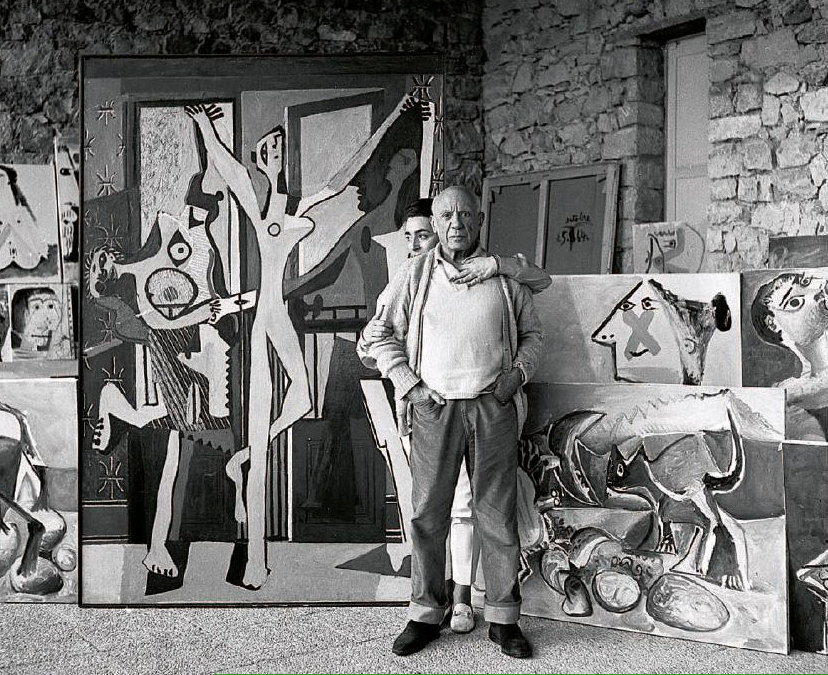
Picasso and ‘The Three Dancers’ 1965 The year the Tate bought it.
(Pic. Lee Miller)
As I thought about it a bit more (Wednesday and Thursday night in the Priory Tavern) I realised that a Picasso Cubist painting or at least a ‘fractured plane’ painting would be ideal because it would allow me to ‘cut up’ the image and distribute it among the class more easily. If I worked out the proportions correctly, each member of the class would have an identically sized piece, which when painted could be assembled the same size as the original. Because of the nature of the original, it wouldn’t matter if the students’ work wasn’t exactly a perfect fit – so they didn’t need to get hung up about that either. I would tell them nothing about their ‘slice’ of the painting. In fact only when all the pieces were complete and the finished painting displayed in school – would they see it for the first time, and then the story behind it revealed. Now then … which painting would fit the bill? What about ‘The Three Dancers’?
And so it was.
You know what? It worked like a dream. We were mixing paint with glue, sand and sawdust to achieve textures, some of the kids went to great lengths to replicate the cracks in the original paint surface – by making actual cracks in their work. It was great fun and the finished group piece went up on display.
A phone call to the Tate Education Department.
‘I’m afraid it’s not on display’
This is not what I wanted to hear. The students had made such a fine job of the ‘patchwork painting’ and were so interested in its story, that I’d (rather hastily) promised to take them to see the real thing.
‘Is it possible to see it in the vaults, or wherever it’s kept when not on display?’
‘You mean The Stores? We only allow that usually under special circumstances’
‘Pleeeeeeeeeeeease’
‘Okay, I’ll see what I can do. Call back in about half an hour’ …..
Which I did:
‘….. I’ve spoken with the Heads of the Education and Curatorial Departments and they have agreed on this one occasion only to allow you access to the stores with your group. Please report to the School’s Reception on arrival.’
Result! We’d done it.
Our Day Out
I hired a small bus and on the appointed day off we went, worksheets fluttering out of the back window, to the Tate and our (by now) beloved ‘Three Dancers’.
Well, it was something else. After leaving our coats and bags in the education area, we were guided – somewhere, unfortunately my memory is hazy about how we got to the Stores, or indeed, beneath the galleries thronging with people above, they were. Before we knew it we were in what resembled a concrete underground car park. The door to the stores, a HUGE door, at least a metre and a half thick was already open in anticipation of our arrival. I pretended to be quite blasé about the whole thing but in fact I was completely overawed by what I was seeing. Over to the left of us was someone I presumed to be our education department guide, waiting for us. The dungarees were a bit of a give away. Behind him, along the length of this cavernous space there were what appeared to be a long series of enormous box files, all slotted together, appropriately labelled on their spines.
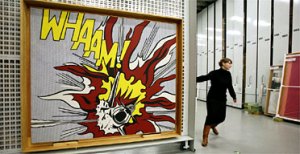
Tate storage.
As we approached, one of the stores staff selected one of these spines, and using a handle about three quarters of the way down, drew out a huge metal grille display panel on wheels. On it was a Georgio de Chirico, a couple of Salvador Dali’s and our ‘Three Dancers’.
‘You okay then?’ Asked the storeman ‘Yes, we’ll be fine, won’t we?’ said our education guide with a cheery smile.
‘Thanks Stan.’
‘ Ten minutes?’
‘Yes Stan, we’ll be done in ten minutes’. Our education guide, introduced himself as Simon.
A sea of hands shot up, all the children shouting at once.
‘Sir! I can’t find my piece!’
Now you never know who you are going to get from the education departments on these sorts of jaunts. I needn’t have worried. Simon announced:
‘Ah! … Any more of that horrible noise and this (he motioned over his shoulder at the painting) goes straight back in. Do you realise how lucky you are to be in here? I’ve worked here for years and this is only the second time I’ve been down here’
My throat had begun to get very dry. ‘Bloody hell, how did I manage to blag this?’ I thought to myself.
Quiet again. Simon began by asking the kids about their paintings in school. To what extent their own individual pieces and then the group piece matched the original. He then studied the original with them, and got the students to look specifically for things they had not spotted in their reproductions and paintings. He then drew their attention to the contorted female face on the left. Why?
The students responded
‘She could have been dead.’
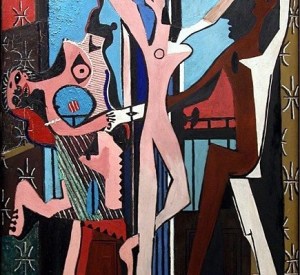
Three Dancers (detail) showing thickness of paint surface left hand side
‘Shot … or’
‘Diseased’
‘What kind of disease?’
‘Aids? … Yeah maybe he wished she had Aids’
‘But what kind of person would wish that on someone?’
‘Someone that hated them’
The Story
And so the story began to unfold …
Just over seven feet high, Picasso painted ‘The Three Dancers’ in spring 1925 in Paris. X-ray images show a much more conventional painting of three more rounded realistic figures beneath. Something had happened to cause Picasso to make a new start and take a more drastic direction. The backdrop to this was his rapidly disintegrating relationship with his wife Olga Kokhlova, a Russian ballet dancer with Diaghilev’s Ballets Russes. The ‘something’ was a death. That of one of Picasso’s oldest friends from his youth in Barcelona, Ramon Pichot. In fact Picasso once said ‘While I was painting this picture an old freind of mine, Ramon Pichot died. I have always felt that it should be called ‘Death of Pichot’ rather than ‘Three Dancers’’
Pichot (or his ghost) appears in the painting as the ghostly black sillhouette on the right. He is significant, because to Picasso, Pichot had been a link back to his formative years in the Catalunyan capital. He was one of a group of regulars at a bar known as Els Quatre Gats, (‘The Four Cats’ which you can still eat and drink at today) When it opened in 1897 it became the centre of the cultural movement known as Modernismo. Another regular was Carles Casagemas. Casagemas and Picasso, who were almost the same age became very close friends. Indeed, at the turn of the century they were sharing a studio for which Casagemas apparently paid.
At the time of his death, Pichot was married – Now this is where it gets interesting or messy depending on your point of view – to none other than Germaine Gargallo: love interest and ultimately subject of obsession, twenty five years earlier of Picasso’s best but increasingly unstable friend, Casagemas. In 1901, while Picasso was in Madrid and his friend in Paris, Germaine finally spurned Casegemas’ advances. He, in response, invites friends, including Germaine for a meal on the Boulevard De Clichy, at the end of which, he stands, produces a pistol which he aims at Germaine and fires. She avoids the bullet and has the sense to stay down and feign injury, whereupon Casagemas turns the pistol to his own right temple. This time he doesn’t miss. His autopsy reveals he was impotent.
Picasso later says that it is Casagemas’suicide that prompts his ‘Blue Period’ and indeed, Casagemas appears in a number of paintings from this era, for example, ‘La Vie’.
‘Alright, let’s get back to the painting and the figures it shows and see if we can tell who they are’
‘ The left has got to be Germaine, Sir’
‘Good. what about the others?
In what strikes me as an innovative move, Simon has invited some of the kids out in front of the painting to get into the positions held by the protagonists and ‘act out the picture’ Top Banana: some Kinaesthetic Learning. Excellent! We have Pichot with his big nose who seems to be part of the futuristic, stylised brown and white figure. To the left, the grinning, grimacing, diseased, gun-shot head of Germaine.
‘Now try to get into that same arched position. How is it?’
‘Painful’
‘Now who’s going to be the middle figure of Olga, Picasso’s wife the ballet dancer?’
Simon picks one of the lads.
‘Come up’ encourages Simon. Our volunteer obliges, and goes on to attempt the stance.
‘Good!’ He has just about been able to clasp hands with his two colleagues.
‘That’s it. Now you’ve got to get your left leg back here … kick it back, that’s it kick it right back!….
I had seen too late what was coming. A perfectly executed back kick, with the knee tucked under the mid section, shoulders square looking away from his opponent (painting) delivering full power through the heel of his flexed foot. Good rotation, balance, strength. Ten out of ten. Jackie Chan would have been proud.
Boom!
The hollow noise as foot contacted with painting reverberated around the stores. As it did, the frame of the painting and the piece of perspex protecting it (thank God it wasn’t glazed!) flexed crazily, like some insane wobble board. I remember the reflected light flashing up and down the painting until it finally settled which took an appallingly long time for it to do.
Simon flashed me a glance which said ‘What the fuck are we going to do?’
I flashed him a glance which said ‘We? What do you mean We? What the fuck are YOU going to do?’
Simon’s face went from white, to grey to a sickly green, like a ghastly traffic light.
Now it may interest you to know that ‘the Three Dancers’ is one of the Tate’s most fragile and friable pieces of work. You may not have noticed, but it never goes out on loan. Nor will it. ‘The Three Dancers’ is an Art conservationist’s nightmare. In fact, the gallery and its powerful conservation staff actively limit its exposure to light to slow down future changes and to preserve this already unstable work for future generations. Picasso, the little rascal enjoyed using commercial oil-based paints which would have had quite different properties to artists’ oil paint. They would have been machine rather than hand ground for a start and not designed for permanence of colour. If you can, take a close look at ‘The Three Dancers’ next time you see it. There some decidedly ropey looking bits and some large cracks. When asked in 1965 about cracks already apparent in the paint surface, Picasso said ‘some people might want to touch them out but I think they add to the painting. On the face you see how they reveal the eye that was originally painted underneath’ He seemed to relish the notion that the viewer now had a glimpse into how he created his work. But I wonder how he would have reacted to it being used for Taekwondo sparring practice?
‘Thank Christ!’ Simon croaked, when it became clear that for some inexplicable reason, the surface of the picture (which is what I had feared for) was alright. I had a mind’s eye image of a perfectly preserved frame and perspex panel featuring at its bottom, a dusty pile of rubble.
‘WellgreatSimonI’msureweallenjoyedthatdidn’twe?Nowit’sprobablytimeforustomakeamove’ I spluttered.
A voice: ‘Okay then?’
I froze: Stan! The storeman was making his way back to us.
‘Everything Okay? I mean you’ve not damaged it have you?’ Laughed Stan.
‘You’ve got no idea ….’ I thought.
Simon went through his traffic-light sequence once again, and we made to leave. Stan none the wiser.
We went back up to Level One, where I thanked Simon for his valuable input, and without another word about what had just happened, he departed.
It was time to get out of there PDQ, so I assembled the kids and made for the bus and home ….
I must say, afterwards I spent a nervous couple weeks, half expecting a letter to delivered to me at school from the Tate’s lawyers, Withers, Linklaters, Brachers demanding to know whether any of our students had touched the picture and if so, requesting an initial payment of $100,000 to cover the cost of repairs.
I am sure Picasso would have been amused. I can hear him laughing: ‘Ug ug ug ug ug!’
© Andy Daly 2014








 Sitting Comfortably?